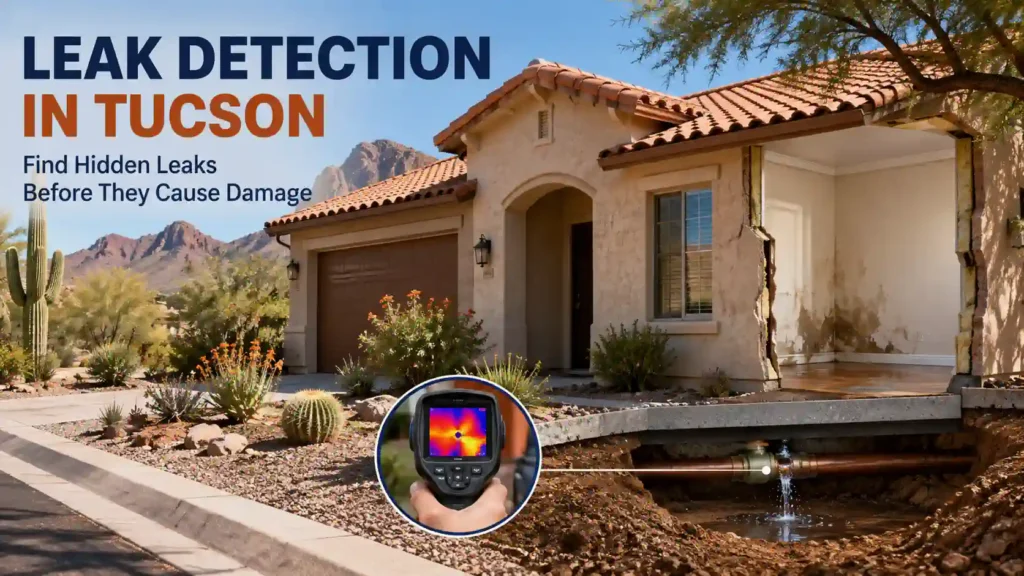
A hidden plumbing leak can waste water for days or even weeks before you notice a puddle. In Tucson, a sudden increase in water use, a damp spot, a running toilet, or the sound of water moving through pipes can all point to a leak that needs attention.
Leak detection in Tucson is the process of locating the source of a water leak, including leaks hidden behind walls, under floors, inside ceilings, underground, or beneath a concrete slab. Finding the exact location early can help limit water damage, wasted water, and the cost of repairs.
The good news is that not every leak requires opening walls or breaking through a floor. Modern plumbers can use water meters, acoustic listening equipment, thermal imaging, pressure testing, moisture meters, and other diagnostic methods to narrow down the location.
Quick Answer: How Do You Know You Have a Water Leak?
Common warning signs include:
- A water bill that suddenly increases without a clear reason
- Your water meter moves when all water fixtures are off
- A toilet runs or refills when nobody has used it
- Damp or discolored areas appear on walls, ceilings, or floors
- Paint begins bubbling, peeling, or staining
- You hear water running when the house is quiet
- Musty odors develop around walls, floors, or cabinets
- Flooring becomes warped or unusually warm
- Water collects in the yard without an obvious source
- Your home’s water pressure changes unexpectedly
Some leaks are easy to see. Others are hidden behind building materials or underground, which is why leak detection is different from simply fixing a dripping faucet.
Why Hidden Water Leaks Can Be Difficult to Find
A leak does not always appear directly above or beside the damaged pipe.
Water can travel along framing, insulation, flooring, or other building materials before becoming visible. A stain on a ceiling, for example, may be several feet away from the actual plumbing problem.
Underground leaks create another challenge. A water line may leak beneath a slab, driveway, landscaping, or other hard-to-access area without producing an obvious puddle.
That is why professional leak detection focuses on finding the source, not just finding where water happens to appear.
Common Types of Plumbing Leaks in Tucson Homes
Different plumbing systems can produce very different leak symptoms.
Slab Leaks
A slab leak occurs when a water pipe beneath a concrete slab develops a leak.
Possible signs include:
- Warm or damp areas on the floor
- Unexplained water near the foundation
- The sound of running water when fixtures are off
- Cracks or moisture problems around flooring
- Unexpectedly high water usage
A slab leak can be especially difficult to diagnose because the pipe is beneath concrete. Accurate detection can help determine where the problem is located before any invasive repair work begins.
Underground Water Line Leaks
A leak in the main water line can occur between the water meter and the house.
Signs may include:
- Continuously moving water meter
- Wet soil
- Unusually green vegetation in one area
- Muddy or soft ground
- Falling water pressure
- A water bill that is higher than normal
Not every wet spot outdoors is a plumbing leak. Irrigation problems, drainage, weather, and landscaping can produce similar symptoms. Testing helps separate these possibilities.
Wall and Ceiling Leaks
Leaks inside walls can remain hidden until moisture reaches the surface.
You may notice:
- Brown or yellow stains
- Bubbling paint
- Soft drywall
- Peeling surfaces
- Mold or mildew odors
- Moisture around cabinets
The visible damage is not necessarily the location of the leaking pipe. A plumber may need to trace the moisture back toward the plumbing system.
Toilet Leaks
Toilet leaks are among the easiest leaks to overlook because much of the water may go directly into the drain.
A worn flapper, fill valve, or other internal component can allow a toilet to run periodically.
One simple test is to put a few drops of food coloring into the toilet tank without flushing. If colored water appears in the bowl after about 10 minutes, the toilet may have an internal leak. Flush afterward to prevent staining.
The EPA recommends this type of basic leak check as part of household leak detection. (US EPA)
Faucet and Fixture Leaks
Dripping faucets, showerheads, hose bibbs, and leaking connections can waste water over time.
These leaks are often easier to locate than hidden pipe leaks, but they should still be repaired. A small visible leak can sometimes be a sign that another component is worn or that water pressure needs attention.
Irrigation Leaks
Outdoor water use deserves special attention in Tucson.
A damaged irrigation line, broken sprinkler, leaking valve, or faulty connection can waste water without being obvious from inside the home.
Look for unusually wet soil, standing water, unusually lush vegetation, or areas of the landscape that stay wet after irrigation has stopped.
How Can You Check for a Hidden Water Leak Yourself?
You can perform a basic leak check before calling a plumber.
Step 1: Turn Off Water Use
Make sure faucets, showers, washing machines, dishwashers, irrigation systems, and other water-using appliances are not running.
Step 2: Check the Water Meter
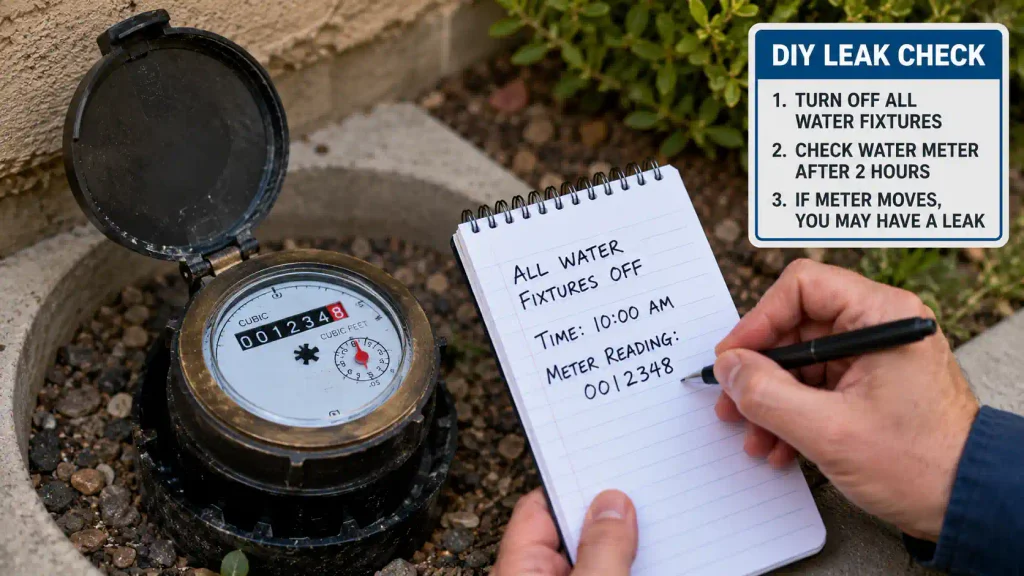
Look at your water meter after water use has stopped.
Wait for a period with no water use and check it again. If the meter reading changes, water may be flowing somewhere in the property.
The EPA recommends checking the meter before and after a two-hour period when no water is being used. A change in the reading can indicate a leak. (US EPA)
Step 3: Check Toilets
Listen for toilets that periodically refill.
You can also use the food-coloring test described above to check for an internal toilet leak.
Step 4: Inspect Visible Plumbing
Look under sinks, around water heaters, near washing machines, around hose connections, and wherever pipes or valves are accessible.
Step 5: Look Outside
Check irrigation areas, hose bibbs, exposed pipes, and soil around the house for unexplained moisture.
If the meter continues showing water use and you cannot find the source, professional leak detection may be the next step.
How Professional Leak Detection Works
A plumber does not necessarily start by cutting into a wall or concrete.
The diagnostic process can involve several methods depending on the type of plumbing system and the symptoms.
Water Meter and Flow Monitoring
A water meter can show whether water is continuously moving through the property.
Tucson Water also explains that flow monitoring devices can identify continuous flow and provide detailed information about water use. Some systems attach to a compatible water meter, while others are installed on the private side of the meter. (Tucson.gov)
Pressure Testing
Pressure testing can help determine whether a plumbing system is holding water pressure as expected.
If pressure drops when the system is isolated, a plumber can investigate whether a leak is present and where additional testing should be performed.
Pressure testing is particularly useful when there is no obvious visible leak.
Acoustic Leak Detection
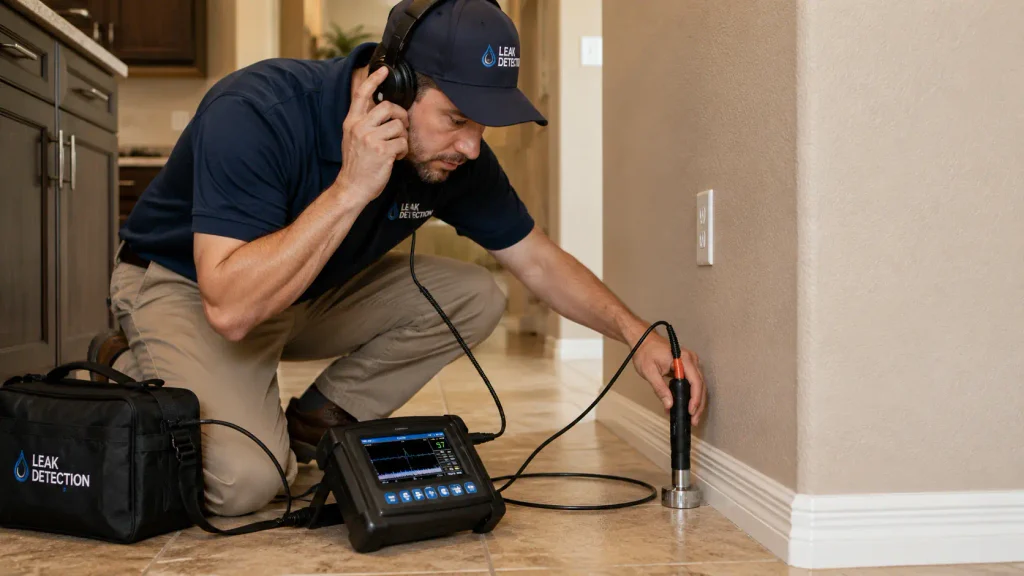
Acoustic equipment can detect sounds created by water escaping from a pressurized pipe.
A technician listens for changes in sound along accessible areas of the plumbing system and uses those readings to narrow down the likely leak location.
This approach can be useful for concealed or underground pressurized water lines.
Thermal Imaging
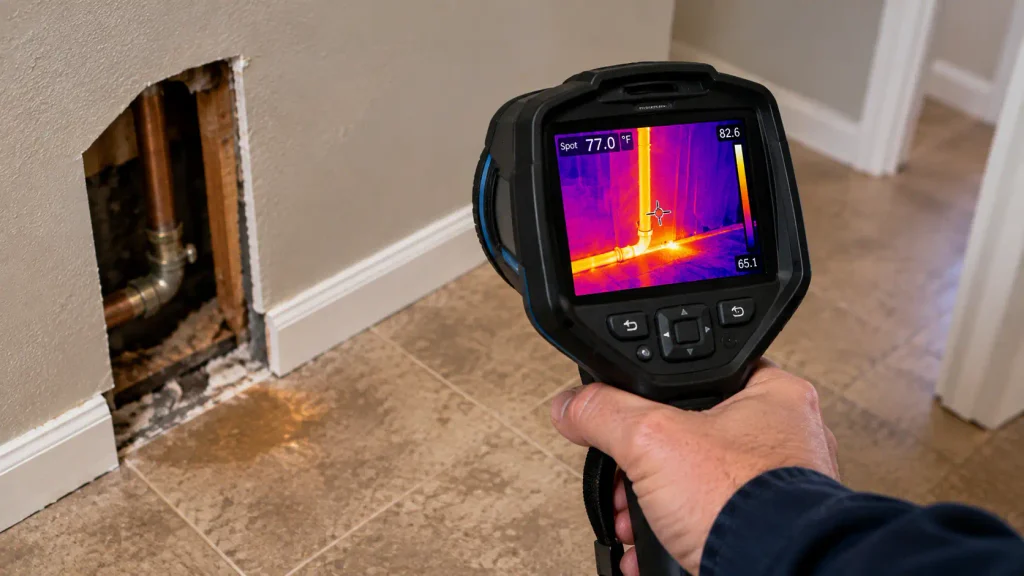
Infrared cameras can identify temperature differences associated with moisture or hot-water leaks.
For example, a hot-water pipe leaking beneath a floor may create a temperature pattern that differs from the surrounding area.
Thermal imaging is a diagnostic aid, not a guarantee. Building materials, ambient temperature, insulation, and the amount of moisture can affect what the camera detects.
Moisture Meters
A moisture meter can help identify areas with elevated moisture inside certain building materials.
This can help determine how far moisture has traveled and whether an apparently dry surface may still contain hidden moisture.
Tracer Gas and Other Specialized Methods
For difficult leaks, specialized techniques may be considered.
The appropriate method depends on the plumbing material, location, accessibility, pressure conditions, and suspected leak type. A good diagnostic process uses the least invasive method that can provide useful information rather than automatically using one technique for every property.
Leak Detection vs. Leak Repair: What’s the Difference?
Leak detection finds the problem. Leak repair fixes the problem.
These are related but different services.
For example, suppose a homeowner notices a constantly running water meter but cannot see any water inside the house.
A plumber may first determine whether there is a leak, isolate parts of the plumbing system, and use diagnostic equipment to narrow down its location.
Once the location and cause are understood, the plumber can recommend the appropriate repair.
That distinction matters because repairing a leak without accurately locating it can result in unnecessary demolition or fixing the wrong part of the plumbing system.
What Causes Plumbing Leaks?
Leaks can develop for many reasons, including:
- Aging pipes
- Corrosion
- Worn seals and valves
- Damaged pipe connections
- Excessive or irregular water pressure
- Poor installation
- Equipment failure
- Physical damage
- Temperature-related pipe problems
- Aging plumbing fixtures
The EPA identifies old piping, corrosion, irregular water pressure, equipment malfunctions, and incorrect installation among the factors that can contribute to household leaks. (US EPA)
The cause also affects the repair. A leaking toilet valve is handled very differently from a damaged underground water line or a pipe beneath a concrete slab.
How Much Water Can a Leak Waste?
Even a leak that seems small can add up over time.
The EPA estimates that household leaks account for an average of more than 9,000 gallons of wasted water per household each year. Nationwide, household leaks account for hundreds of billions of gallons of wasted water annually. (US EPA)
The actual amount depends on the leak’s flow rate and how long it remains undetected.
That is why a higher-than-normal water bill can be an important early warning sign.
Why Leak Detection Matters in Tucson
Water conservation is especially important in desert communities.
Tucson Water provides resources for homeowners to monitor water use and identify possible leaks. The City notes that flow monitoring devices can detect continuous flow and help homeowners understand how water is being used around the property. (Tucson.gov)
A leak detection system can also provide an earlier warning than a monthly utility bill.
Some modern systems monitor flow patterns, send alerts to a phone, and may offer automatic shutoff features. The EPA notes that leak detection and flow monitoring devices can use moisture detection or water-flow monitoring to identify irregular water use. (US EPA)
Should You Install a Home Leak Detection Device?
A leak detection or flow monitoring device can be useful for homeowners who want ongoing visibility into water use.
There are two broad approaches:
| Type | What It Monitors | Best Use |
|---|---|---|
| Moisture sensor | Unexpected moisture in a specific area | Water heaters, appliances, sinks, vulnerable areas |
| Flow monitor | Water moving through the plumbing system | Detecting unusual or continuous water use |
Some systems can do more than send an alert. Depending on the product, they may monitor flow patterns, provide app notifications, track water use, or control a shutoff valve.
Tucson Water notes that compatibility should be checked before installing a device that attaches directly to a City water meter. (Tucson.gov)
A monitoring device does not replace professional diagnosis. It can tell you that something unusual is happening; it may not tell you exactly where a concealed pipe is leaking.
When Should You Call a Plumber for Leak Detection?
Consider professional help when:
- Your water meter shows continuous flow with everything turned off.
- Your water bill has increased without a clear explanation.
- You hear water running inside walls or floors.
- You find unexplained moisture.
- A ceiling or wall repeatedly becomes wet.
- You suspect a slab leak.
- You suspect an underground water line leak.
- You cannot locate the source of a leak.
- You see signs of water damage but cannot identify the plumbing cause.
A leak that is actively causing damage deserves prompt attention. If water is accumulating near electrical equipment or creating an immediate safety concern, avoid contact with the affected area and address the hazard first.
What Happens During a Professional Leak Detection Visit?
The exact process depends on the symptoms, but a typical diagnostic visit may include:
- Discussing the symptoms — The technician asks about water bills, sounds, moisture, pressure changes, and when the problem occurs.
- Checking water usage — The technician may inspect the meter or other available flow information.
- Isolating plumbing sections — Different parts of the system can be tested separately.
- Testing pressure — Pressure behavior can help confirm whether a leak is present.
- Using specialized equipment — Acoustic, thermal, moisture, or other diagnostic tools may help locate concealed leaks.
- Identifying the likely source — The goal is to narrow the problem to a practical repair location.
- Recommending repair options — Once the leak is located, the plumber can explain what needs to be repaired and whether access work is required.
The exact tools used should match the plumbing problem. A visible faucet leak does not need the same diagnostic process as a suspected underground pipe leak.
Leak Detection Can Help Limit Unnecessary Damage
One of the biggest benefits of accurate leak detection is knowing where to look before opening up a structure.
Consider a pipe leaking beneath a concrete floor. Without a clear diagnosis, a repair may require more exploratory work than necessary.
With accurate leak location, the plumber can often target the affected area more precisely.
That does not mean every repair will be small. Some leaks require substantial access or pipe replacement. The value of leak detection is that the repair decision is based on better information.
Frequently Asked Questions About Leak Detection in Tucson
How do I know if I have a hidden water leak?
Check your water meter when no water is being used. If the meter continues to register water use, investigate the property for a leak. Other warning signs include unexplained moisture, sounds of running water, damaged surfaces, and an unusually high water bill.
Can a plumber find a leak without breaking the floor?
Often, yes. Depending on the situation, plumbers can use pressure testing, acoustic equipment, thermal imaging, moisture meters, and other diagnostic techniques to narrow down a leak before invasive access is considered.
However, no detection method can guarantee a completely non-invasive repair. Some leaks eventually require access to the pipe.
Can a high water bill mean I have a leak?
Yes. A sudden unexplained increase in water use can be a warning sign of a leak. Compare your current usage with previous bills and check the property for continuous water flow.
Can a leak be underground?
Yes. Water lines and irrigation pipes can leak underground. Signs can include unexplained wet soil, unusually green vegetation, standing water, or continuous meter movement.
What is a slab leak?
A slab leak is a leak in a water pipe located beneath a concrete slab. Because the pipe is hidden, detection may require specialized diagnostic testing.
Are leak detection devices worth it?
They can be useful for homeowners who want early warnings about unusual water use or unexpected moisture. They are especially helpful as an ongoing monitoring tool, but they should not be viewed as a replacement for professional diagnosis when a leak is suspected.
How quickly should a hidden leak be fixed?
A suspected active leak should be investigated as soon as practical. The longer water escapes, the greater the potential for wasted water and damage to building materials.
Find the Source Before the Damage Gets Worse
A hidden water leak does not always announce itself with a puddle. Sometimes the first clue is a higher water bill, a moving meter, a damp wall, or a strange sound behind the floor.
The goal of professional leak detection in Tucson is to turn those clues into a clear diagnosis.
If basic checks show that water is being used when everything is turned off, or you have signs of a concealed leak, a qualified plumbing professional can determine whether the problem is coming from a fixture, supply line, underground pipe, slab plumbing, irrigation system, or another part of the property.
For Tucson homeowners, early detection can mean less wasted water, less property damage, and a clearer path to the right repair.
Related resource: If you are looking for professional help, see our guide to Leak Detection Plumbers in Tucson for plumbers who provide leak detection services in the Tucson area.
A hidden plumbing leak can waste water for days or even weeks before you notice a puddle. In Tucson, a sudden increase in water use, a damp spot, a running toilet, or the sound of water moving through pipes can all point to a leak that needs attention.
Leak detection in Tucson is the process of locating the source of a water leak, including leaks hidden behind walls, under floors, inside ceilings, underground, or beneath a concrete slab. Finding the exact location early can help limit water damage, wasted water, and the cost of repairs.
The good news is that not every leak requires opening walls or breaking through a floor. Modern plumbers can use water meters, acoustic listening equipment, thermal imaging, pressure testing, moisture meters, and other diagnostic methods to narrow down the location.
Quick Answer: How Do You Know You Have a Water Leak?
Common warning signs include:
- A water bill that suddenly increases without a clear reason
- Your water meter moves when all water fixtures are off
- A toilet runs or refills when nobody has used it
- Damp or discolored areas appear on walls, ceilings, or floors
- Paint begins bubbling, peeling, or staining
- You hear water running when the house is quiet
- Musty odors develop around walls, floors, or cabinets
- Flooring becomes warped or unusually warm
- Water collects in the yard without an obvious source
- Your home’s water pressure changes unexpectedly
Some leaks are easy to see. Others are hidden behind building materials or underground, which is why leak detection is different from simply fixing a dripping faucet.
Why Hidden Water Leaks Can Be Difficult to Find
A leak does not always appear directly above or beside the damaged pipe.
Water can travel along framing, insulation, flooring, or other building materials before becoming visible. A stain on a ceiling, for example, may be several feet away from the actual plumbing problem.
Underground leaks create another challenge. A water line may leak beneath a slab, driveway, landscaping, or other hard-to-access area without producing an obvious puddle.
That is why professional leak detection focuses on finding the source, not just finding where water happens to appear.
Common Types of Plumbing Leaks in Tucson Homes
Different plumbing systems can produce very different leak symptoms.
Slab Leaks
A slab leak occurs when a water pipe beneath a concrete slab develops a leak.
Possible signs include:
- Warm or damp areas on the floor
- Unexplained water near the foundation
- The sound of running water when fixtures are off
- Cracks or moisture problems around flooring
- Unexpectedly high water usage
A slab leak can be especially difficult to diagnose because the pipe is beneath concrete. Accurate detection can help determine where the problem is located before any invasive repair work begins.
Underground Water Line Leaks
A leak in the main water line can occur between the water meter and the house.
Signs may include:
- Continuously moving water meter
- Wet soil
- Unusually green vegetation in one area
- Muddy or soft ground
- Falling water pressure
- A water bill that is higher than normal
Not every wet spot outdoors is a plumbing leak. Irrigation problems, drainage, weather, and landscaping can produce similar symptoms. Testing helps separate these possibilities.
Wall and Ceiling Leaks
Leaks inside walls can remain hidden until moisture reaches the surface.
You may notice:
- Brown or yellow stains
- Bubbling paint
- Soft drywall
- Peeling surfaces
- Mold or mildew odors
- Moisture around cabinets
The visible damage is not necessarily the location of the leaking pipe. A plumber may need to trace the moisture back toward the plumbing system.
Toilet Leaks
Toilet leaks are among the easiest leaks to overlook because much of the water may go directly into the drain.
A worn flapper, fill valve, or other internal component can allow a toilet to run periodically.
One simple test is to put a few drops of food coloring into the toilet tank without flushing. If colored water appears in the bowl after about 10 minutes, the toilet may have an internal leak. Flush afterward to prevent staining.
The EPA recommends this type of basic leak check as part of household leak detection. (US EPA)
Faucet and Fixture Leaks
Dripping faucets, showerheads, hose bibbs, and leaking connections can waste water over time.
These leaks are often easier to locate than hidden pipe leaks, but they should still be repaired. A small visible leak can sometimes be a sign that another component is worn or that water pressure needs attention.
Irrigation Leaks
Outdoor water use deserves special attention in Tucson.
A damaged irrigation line, broken sprinkler, leaking valve, or faulty connection can waste water without being obvious from inside the home.
Look for unusually wet soil, standing water, unusually lush vegetation, or areas of the landscape that stay wet after irrigation has stopped.
How Can You Check for a Hidden Water Leak Yourself?
You can perform a basic leak check before calling a plumber.
Step 1: Turn Off Water Use
Make sure faucets, showers, washing machines, dishwashers, irrigation systems, and other water-using appliances are not running.
Step 2: Check the Water Meter
Look at your water meter after water use has stopped.
Wait for a period with no water use and check it again. If the meter reading changes, water may be flowing somewhere in the property.
The EPA recommends checking the meter before and after a two-hour period when no water is being used. A change in the reading can indicate a leak. (US EPA)
Step 3: Check Toilets
Listen for toilets that periodically refill.
You can also use the food-coloring test described above to check for an internal toilet leak.
Step 4: Inspect Visible Plumbing
Look under sinks, around water heaters, near washing machines, around hose connections, and wherever pipes or valves are accessible.
Step 5: Look Outside
Check irrigation areas, hose bibbs, exposed pipes, and soil around the house for unexplained moisture.
If the meter continues showing water use and you cannot find the source, professional leak detection may be the next step.
How Professional Leak Detection Works
A plumber does not necessarily start by cutting into a wall or concrete.
The diagnostic process can involve several methods depending on the type of plumbing system and the symptoms.
Water Meter and Flow Monitoring
A water meter can show whether water is continuously moving through the property.
Tucson Water also explains that flow monitoring devices can identify continuous flow and provide detailed information about water use. Some systems attach to a compatible water meter, while others are installed on the private side of the meter. (Tucson.gov)
Pressure Testing
Pressure testing can help determine whether a plumbing system is holding water pressure as expected.
If pressure drops when the system is isolated, a plumber can investigate whether a leak is present and where additional testing should be performed.
Pressure testing is particularly useful when there is no obvious visible leak.
Acoustic Leak Detection
Acoustic equipment can detect sounds created by water escaping from a pressurized pipe.
A technician listens for changes in sound along accessible areas of the plumbing system and uses those readings to narrow down the likely leak location.
This approach can be useful for concealed or underground pressurized water lines.
Thermal Imaging
Infrared cameras can identify temperature differences associated with moisture or hot-water leaks.
For example, a hot-water pipe leaking beneath a floor may create a temperature pattern that differs from the surrounding area.
Thermal imaging is a diagnostic aid, not a guarantee. Building materials, ambient temperature, insulation, and the amount of moisture can affect what the camera detects.
Moisture Meters
A moisture meter can help identify areas with elevated moisture inside certain building materials.
This can help determine how far moisture has traveled and whether an apparently dry surface may still contain hidden moisture.
Tracer Gas and Other Specialized Methods
For difficult leaks, specialized techniques may be considered.
The appropriate method depends on the plumbing material, location, accessibility, pressure conditions, and suspected leak type. A good diagnostic process uses the least invasive method that can provide useful information rather than automatically using one technique for every property.
Leak Detection vs. Leak Repair: What’s the Difference?
Leak detection finds the problem. Leak repair fixes the problem.
These are related but different services.
For example, suppose a homeowner notices a constantly running water meter but cannot see any water inside the house.
A plumber may first determine whether there is a leak, isolate parts of the plumbing system, and use diagnostic equipment to narrow down its location.
Once the location and cause are understood, the plumber can recommend the appropriate repair.
That distinction matters because repairing a leak without accurately locating it can result in unnecessary demolition or fixing the wrong part of the plumbing system.
What Causes Plumbing Leaks?
Leaks can develop for many reasons, including:
- Aging pipes
- Corrosion
- Worn seals and valves
- Damaged pipe connections
- Excessive or irregular water pressure
- Poor installation
- Equipment failure
- Physical damage
- Temperature-related pipe problems
- Aging plumbing fixtures
The EPA identifies old piping, corrosion, irregular water pressure, equipment malfunctions, and incorrect installation among the factors that can contribute to household leaks. (US EPA)
The cause also affects the repair. A leaking toilet valve is handled very differently from a damaged underground water line or a pipe beneath a concrete slab.
How Much Water Can a Leak Waste?
Even a leak that seems small can add up over time.
The EPA estimates that household leaks account for an average of more than 9,000 gallons of wasted water per household each year. Nationwide, household leaks account for hundreds of billions of gallons of wasted water annually. (US EPA)
The actual amount depends on the leak’s flow rate and how long it remains undetected.
That is why a higher-than-normal water bill can be an important early warning sign.
Why Leak Detection Matters in Tucson
Water conservation is especially important in desert communities.
Tucson Water provides resources for homeowners to monitor water use and identify possible leaks. The City notes that flow monitoring devices can detect continuous flow and help homeowners understand how water is being used around the property. (Tucson.gov)
A leak detection system can also provide an earlier warning than a monthly utility bill.
Some modern systems monitor flow patterns, send alerts to a phone, and may offer automatic shutoff features. The EPA notes that leak detection and flow monitoring devices can use moisture detection or water-flow monitoring to identify irregular water use. (US EPA)
Should You Install a Home Leak Detection Device?
A leak detection or flow monitoring device can be useful for homeowners who want ongoing visibility into water use.
There are two broad approaches:
| Type | What It Monitors | Best Use |
|---|---|---|
| Moisture sensor | Unexpected moisture in a specific area | Water heaters, appliances, sinks, vulnerable areas |
| Flow monitor | Water moving through the plumbing system | Detecting unusual or continuous water use |
Some systems can do more than send an alert. Depending on the product, they may monitor flow patterns, provide app notifications, track water use, or control a shutoff valve.
Tucson Water notes that compatibility should be checked before installing a device that attaches directly to a City water meter. (Tucson.gov)
A monitoring device does not replace professional diagnosis. It can tell you that something unusual is happening; it may not tell you exactly where a concealed pipe is leaking.
When Should You Call a Plumber for Leak Detection?
Consider professional help when:
- Your water meter shows continuous flow with everything turned off.
- Your water bill has increased without a clear explanation.
- You hear water running inside walls or floors.
- You find unexplained moisture.
- A ceiling or wall repeatedly becomes wet.
- You suspect a slab leak.
- You suspect an underground water line leak.
- You cannot locate the source of a leak.
- You see signs of water damage but cannot identify the plumbing cause.
A leak that is actively causing damage deserves prompt attention. If water is accumulating near electrical equipment or creating an immediate safety concern, avoid contact with the affected area and address the hazard first.
What Happens During a Professional Leak Detection Visit?
The exact process depends on the symptoms, but a typical diagnostic visit may include:
- Discussing the symptoms — The technician asks about water bills, sounds, moisture, pressure changes, and when the problem occurs.
- Checking water usage — The technician may inspect the meter or other available flow information.
- Isolating plumbing sections — Different parts of the system can be tested separately.
- Testing pressure — Pressure behavior can help confirm whether a leak is present.
- Using specialized equipment — Acoustic, thermal, moisture, or other diagnostic tools may help locate concealed leaks.
- Identifying the likely source — The goal is to narrow the problem to a practical repair location.
- Recommending repair options — Once the leak is located, the plumber can explain what needs to be repaired and whether access work is required.
The exact tools used should match the plumbing problem. A visible faucet leak does not need the same diagnostic process as a suspected underground pipe leak.
Leak Detection Can Help Limit Unnecessary Damage
One of the biggest benefits of accurate leak detection is knowing where to look before opening up a structure.
Consider a pipe leaking beneath a concrete floor. Without a clear diagnosis, a repair may require more exploratory work than necessary.
With accurate leak location, the plumber can often target the affected area more precisely.
That does not mean every repair will be small. Some leaks require substantial access or pipe replacement. The value of leak detection is that the repair decision is based on better information.
Frequently Asked Questions About Leak Detection in Tucson
How do I know if I have a hidden water leak?
Check your water meter when no water is being used. If the meter continues to register water use, investigate the property for a leak. Other warning signs include unexplained moisture, sounds of running water, damaged surfaces, and an unusually high water bill.
Can a plumber find a leak without breaking the floor?
Often, yes. Depending on the situation, plumbers can use pressure testing, acoustic equipment, thermal imaging, moisture meters, and other diagnostic techniques to narrow down a leak before invasive access is considered.
However, no detection method can guarantee a completely non-invasive repair. Some leaks eventually require access to the pipe.
Can a high water bill mean I have a leak?
Yes. A sudden unexplained increase in water use can be a warning sign of a leak. Compare your current usage with previous bills and check the property for continuous water flow.
Can a leak be underground?
Yes. Water lines and irrigation pipes can leak underground. Signs can include unexplained wet soil, unusually green vegetation, standing water, or continuous meter movement.
What is a slab leak?
A slab leak is a leak in a water pipe located beneath a concrete slab. Because the pipe is hidden, detection may require specialized diagnostic testing.
Are leak detection devices worth it?
They can be useful for homeowners who want early warnings about unusual water use or unexpected moisture. They are especially helpful as an ongoing monitoring tool, but they should not be viewed as a replacement for professional diagnosis when a leak is suspected.
How quickly should a hidden leak be fixed?
A suspected active leak should be investigated as soon as practical. The longer water escapes, the greater the potential for wasted water and damage to building materials.
Find the Source Before the Damage Gets Worse
A hidden water leak does not always announce itself with a puddle. Sometimes the first clue is a higher water bill, a moving meter, a damp wall, or a strange sound behind the floor.
The goal of professional leak detection in Tucson is to turn those clues into a clear diagnosis.
If basic checks show that water is being used when everything is turned off, or you have signs of a concealed leak, a qualified plumbing professional can determine whether the problem is coming from a fixture, supply line, underground pipe, slab plumbing, irrigation system, or another part of the property.
For Tucson homeowners, early detection can mean less wasted water, less property damage, and a clearer path to the right repair.
Related resource: If you are looking for professional help, see our guide to Leak Detection Plumbers in Tucson for plumbers who provide leak detection services in the Tucson area.

Leave a Reply