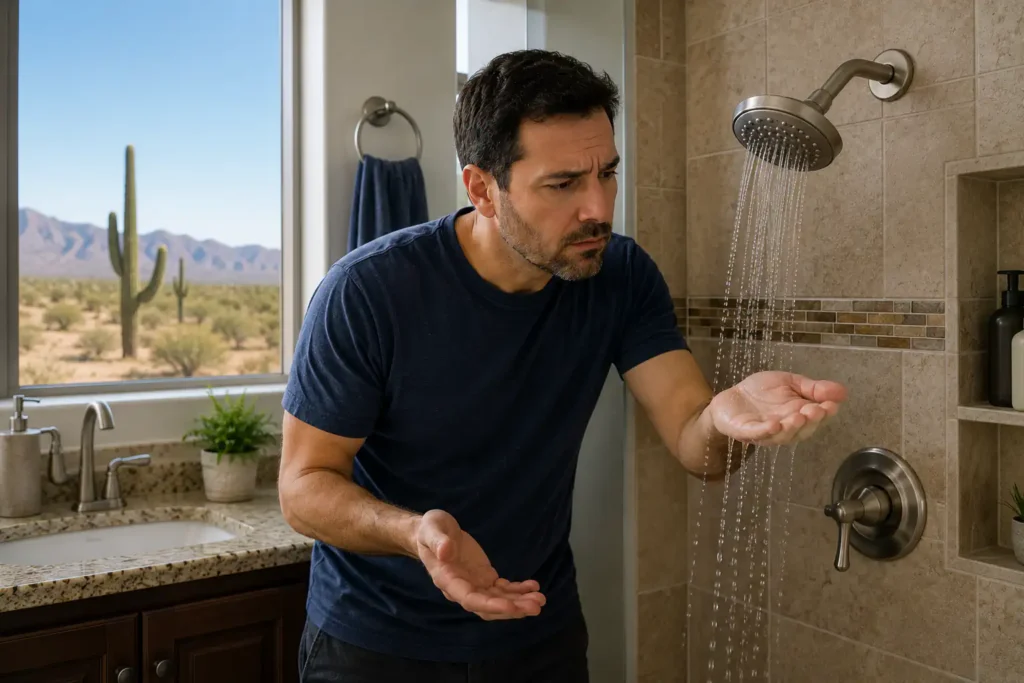
Low water pressure can turn simple household tasks into a daily frustration. Your shower may feel weak, the kitchen faucet may barely flow, or it may take much longer to fill a bathtub, washing machine, or toilet tank.
In Tucson, low water pressure can have several causes. The issue may come from a clogged faucet aerator, mineral buildup inside a fixture, a pressure-regulating valve, a leak, or a problem with the home’s water service line. Tucson Water also notes that pressure can vary across its service area and even between nearby customers. Construction, pressure-regulating valves, and leaks in the customer zone can affect pressure.
The good news is that you can perform a few simple checks before calling a plumber. The key is determining whether the problem affects one fixture, one part of the house, or the entire property.
What Is Normal Water Pressure for a Tucson Home?
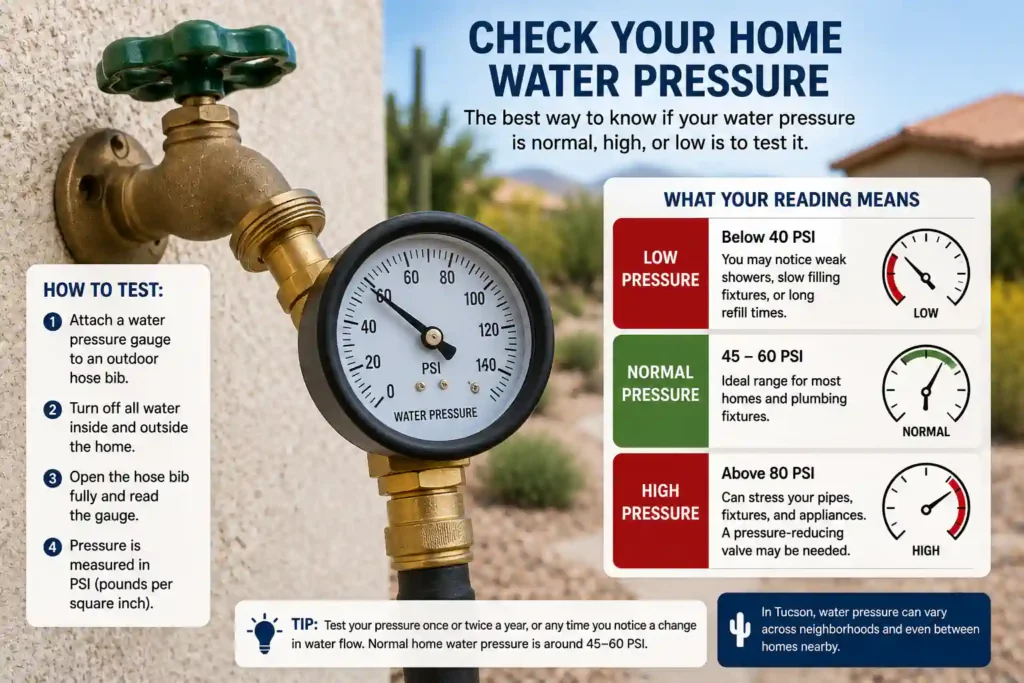
For most household fixtures, the EPA WaterSense program says incoming home water pressure works best around 45 to 60 pounds per square inch (psi). You can check your home’s pressure with an inexpensive water pressure gauge attached to an outdoor hose bib.
Tucson’s water distribution system is more complicated than one citywide pressure number. Tucson Water’s design standards indicate that static pressure at the water service connection can generally range from 35 to 85 psi in single zones, while some dual-zone areas can have a wider range because of elevation and local conditions.
That means a home in one part of Tucson may not have exactly the same pressure as a home a short distance away.
For your house, the useful question is not simply, “What is Tucson’s water pressure?” It is:
What pressure is reaching my home, and is it lower than what my plumbing system normally receives?
How to Tell If Your Water Pressure Is Too Low
You may have a water pressure problem if you notice:
- A weak shower stream
- A kitchen faucet with low flow
- A slow-filling bathtub
- A toilet tank that takes a long time to refill
- Several fixtures becoming weak at the same time
- A sprinkler system that is not performing normally
- Water pressure dropping sharply when another fixture is running
- Pressure that is noticeably weaker than it used to be
One important clue is when the low pressure occurs.
If only one faucet is affected, the problem is probably local to that fixture.
If every faucet and shower in the house is weak, the problem is more likely related to the home’s water supply, pressure regulation, plumbing, or service line.
Is Low Water Pressure Common in Tucson?
Low water pressure is not necessarily a problem with the entire Tucson water system.
Tucson Water says pressure can vary across its service area and even between nearby customers. The utility lists several possible factors, including construction, a malfunctioning pressure-regulating valve, and leaks within the customer zone.
Tucson also has significant elevation changes and a large water distribution network. Tucson Water operates thousands of miles of pipeline along with booster stations and pressure-control equipment to manage water delivery.
So if your Tucson home suddenly develops weak water pressure, it is better to investigate the specific property rather than assume the citywide supply is the cause.
Low Water Pressure at Only One Faucet or Fixture
If the pressure is normal everywhere else, start with the affected fixture.
Clogged Faucet Aerator
A faucet aerator is the small screen fitted to the end of many faucets.
Minerals and debris can collect inside it and restrict water flow.
This is especially worth checking in Tucson because Tucson Water describes the area’s water as hard, with calcium and magnesium that can form mineral deposits. The utility specifically notes that hard water can clog faucet aerators and showerheads.
Remove the aerator and inspect the screen.
If it is covered with white or chalky buildup, clean or replace it and test the faucet again.
Clogged Showerhead
A showerhead can develop the same problem.
If your bathroom sink has good pressure but the shower is weak, the showerhead itself may be restricting flow.
Cleaning the showerhead can sometimes restore normal flow without any plumbing repair.
Partially Closed Fixture Valve
Check the small shutoff valves underneath the sink or behind the toilet.
A valve that is not fully open can reduce flow to that fixture.
Do not force a valve that is stuck, corroded, or leaking. Older shutoff valves can fail when they are disturbed.
Low Water Pressure Throughout the House
If every faucet and shower has weak flow, the problem is more likely to be somewhere between the water supply and the individual fixtures.
Possible causes include:
- A pressure-regulating valve problem
- A leak
- A partially closed main shutoff valve
- Mineral buildup in older plumbing
- A damaged or restricted water service line
- A problem with the incoming water supply
- A water treatment system restricting flow
- A pressure issue affecting the property
This is where measuring the pressure becomes much more useful than guessing.
Check Your Home’s Water Pressure With a Gauge
One of the easiest diagnostic steps is to test the pressure at an outdoor hose bib.
The EPA recommends using a water pressure test gauge, which can be purchased from a hardware store. Turn off water-using fixtures and appliances before testing, attach the gauge to the hose bib, and open the water supply fully.
What the Reading Can Tell You
A reading around 45 to 60 psi is generally a useful target range for normal household fixture operation.
If the reading is substantially below that range, investigate further rather than immediately replacing plumbing equipment.
If the pressure is unusually high, that is also worth addressing. Excessive pressure can place additional stress on plumbing fixtures, valves, appliances, and connections.
A pressure reading is especially useful when you compare it with what you have experienced in the past.
For example:
Previously: 55 psi
Now: 32 psi
That is a much stronger clue than simply saying, “The shower feels weak.”
Check the Main Water Shutoff Valve
Your home’s main water shutoff valve controls the water entering the property.
If it has been partially closed after plumbing work, remodeling, landscaping, or another repair, the reduced opening can restrict flow.
The valve may be located:
- Near where the water line enters the house
- Near the water meter
- In a utility area
- In a garage
- In another designated plumbing access area
The exact location varies by home.
If the valve appears fully open but is difficult to operate, do not force it. A plumber can determine whether the valve is functioning correctly.
Could a Pressure-Regulating Valve Cause Low Water Pressure?
Yes.
A pressure-regulating valve (PRV) controls incoming water pressure in homes where pressure needs to be reduced or maintained within a suitable range.
A malfunctioning PRV can cause pressure to become too low, unstable, or inconsistent.
Tucson Water specifically identifies a malfunctioning pressure-regulating valve as one possible reason for low water pressure in the customer zone.
Signs of a possible PRV problem include:
- Pressure is low throughout the house
- Pressure changes noticeably without explanation
- The pressure was normal in the past
- Multiple fixtures are affected
- A pressure gauge shows an unusual or unstable reading
Because a PRV is part of the home’s water-pressure control system, diagnosing and replacing one may be better left to a qualified plumber.
Can Hard Water Cause Low Water Pressure in Tucson?
It can contribute to restricted flow, particularly when mineral deposits accumulate over time.
Tucson Water states that local water can be hard to very hard and that calcium buildup can clog taps. The utility also explains that limescale buildup can restrict water flow through pipes and affect water-using equipment.
However, hard water should not automatically be blamed whenever pressure drops.
Mineral buildup is more likely to be the problem when:
- Pressure has gradually declined
- Only certain fixtures are affected
- Faucet aerators are visibly clogged
- Showerheads have mineral deposits
- Older plumbing has a history of scale buildup
A sudden, whole-house pressure drop points toward other possibilities, such as a valve problem, leak, or supply issue.
Could a Water Softener or Filter Reduce Water Pressure?
A water softener or filtration system can affect flow if the system is improperly sized, poorly maintained, or has a restriction.
For example, a clogged filter cartridge can reduce the amount of water passing through the system.
If the pressure is normal before the treatment equipment but drops significantly after it, that provides an important diagnostic clue.
Check the manufacturer’s maintenance recommendations and filter condition before assuming the home’s entire plumbing system has a pressure problem.
Tucson Water also notes that home treatment systems need regular maintenance and that hard water can affect these systems.
Could a Water Leak Cause Low Pressure?
Yes.
A significant leak can reduce the amount of water available to fixtures, particularly when the leak is on the home’s service line or another major supply pipe.
Look for clues such as:
- An unexpectedly high water bill
- Wet areas in the yard
- Sound of running water when everything is turned off
- Damp areas near plumbing
- Sudden pressure loss
- Water meter movement when no fixtures are being used
A hidden leak can waste a large amount of water while also creating a pressure problem.
If you suspect a leak on your property, have it investigated promptly.
Could Old Plumbing Cause Low Water Pressure?
Yes, particularly in older homes where internal supply pipes have become restricted over many years.
Mineral deposits, corrosion, and buildup can reduce the effective inside diameter of a pipe.
Think of it this way:
A new pipe provides a relatively open path for water.
A heavily restricted pipe provides a much smaller path.
Even if the incoming water pressure is normal, less water may reach the faucet.
This can explain why an older house may have acceptable pressure at the service connection but poor flow at certain fixtures.
The solution may involve repairing or replacing restricted sections of plumbing rather than adjusting a pressure valve.
Low Pressure vs. Low Water Flow: They Are Not Always the Same
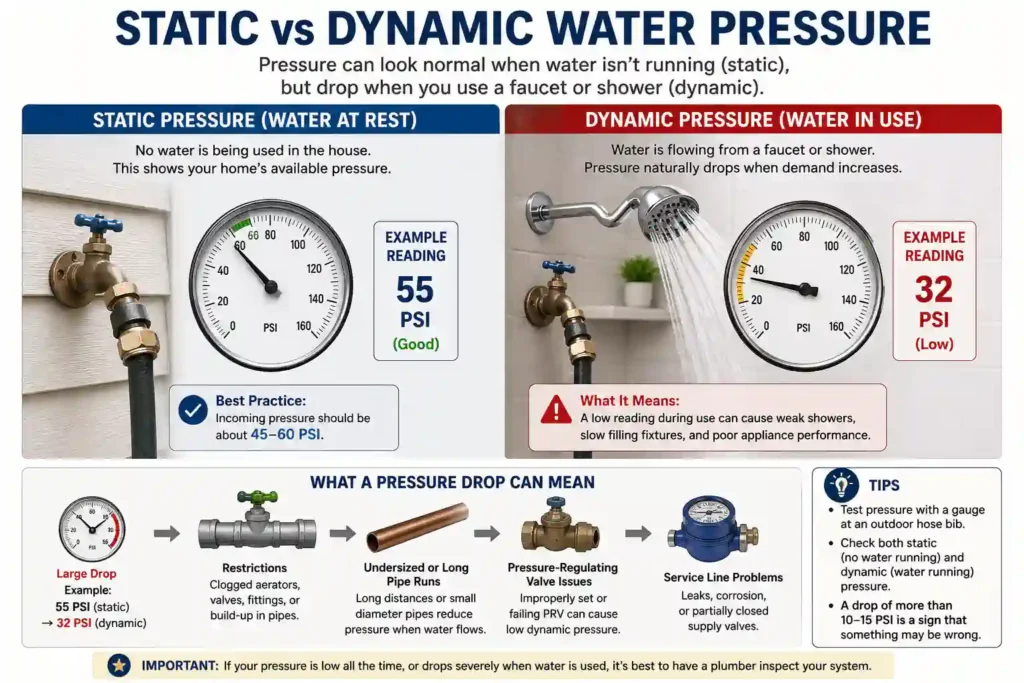
This distinction is important.
Water pressure is the force pushing water through the plumbing system.
Water flow is the amount of water actually coming through a fixture over a period of time.
A faucet can have reasonable static pressure but poor flow because of a clogged aerator, restricted pipe, partially closed valve, or another obstruction.
For example, if a pressure gauge shows 55 psi but the kitchen faucet has a weak stream, the problem may be at the faucet rather than the home’s incoming pressure.
That is why both pressure testing and fixture inspection can be useful.
What to Check Before Calling a Plumber
Try these simple checks first:
1. Test More Than One Fixture
Turn on the kitchen faucet, bathroom faucet, and shower.
If only one fixture is weak, start there.
If everything is weak, investigate the main water supply and pressure.
2. Check Faucet Aerators
Remove a weak faucet’s aerator and look for mineral deposits or debris.
3. Inspect the Showerhead
Look for visible scale or blocked openings.
4. Check Fixture Shutoff Valves
Make sure the valves under sinks and behind toilets are fully open.
5. Check the Main Shutoff
Confirm that the home’s main water valve has not been partially closed.
6. Test the Water Pressure
Use a pressure gauge on an outdoor hose bib with water use turned off.
7. Check for Signs of a Leak
Look at the water meter, yard, plumbing areas, and recent water bills for unusual changes.
If these checks do not explain the problem, professional diagnosis may save time and prevent unnecessary part replacement.
When Should You Call a Plumber?
Call a plumber when low water pressure:
- Affects the entire house
- Appears suddenly
- Keeps getting worse
- Comes with a suspected leak
- Occurs with unusual noises
- Is accompanied by pipe corrosion or visible damage
- Continues after cleaning fixtures
- Appears related to a PRV
- Occurs after plumbing or remodeling work
- Comes with other plumbing problems
You should also consider professional help when you need to work on the main water line, pressure-regulating valve, hidden plumbing, or other components that require specialized tools or experience.
How Much Does It Cost to Fix Low Water Pressure?
There is no single price because the repair depends on the cause.
Cleaning a clogged faucet aerator may cost almost nothing if you handle it yourself.
A plumber may charge for diagnosis and labor if the problem involves a pressure-regulating valve, leak, restricted water line, or other plumbing component.
Before approving a larger repair, ask:
- What is causing the low pressure?
- Where was the problem found?
- What repair is recommended?
- Can the existing component be repaired or does it need replacement?
- Is there a diagnostic or service-call fee?
- Does the estimate include labor and materials?
- Could additional problems be discovered after the repair begins?
For more involved plumbing work, a written estimate can make it easier to compare providers.
When Is Low Water Pressure an Emergency?
Low water pressure by itself is usually not an emergency.
However, the situation becomes more urgent if the pressure problem occurs together with signs of a major leak or plumbing failure.
For example, act quickly if you notice:
- Water pouring from a damaged pipe
- Rapidly spreading water damage
- A flooded area
- A major leak near electrical equipment
- A sudden loss of water accompanied by visible pipe damage
- Sewage or contaminated water entering the home
In those situations, shut off the appropriate water supply if you can do so safely and contact the appropriate professional.
Tucson-Specific Considerations for Low Water Pressure
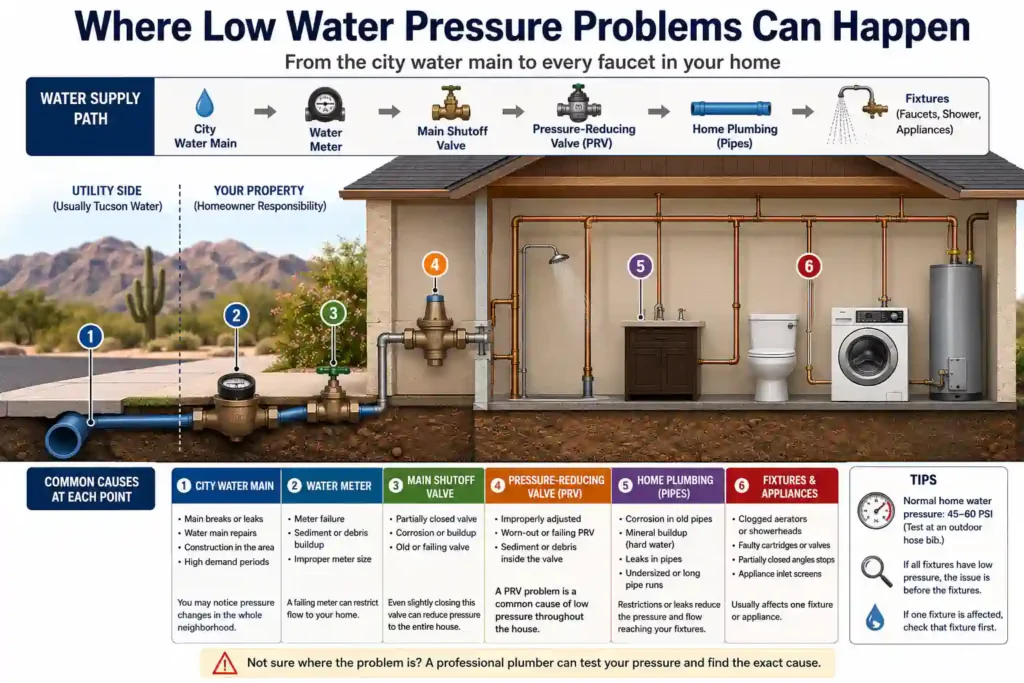
Tucson homeowners have a few local factors worth keeping in mind.
First, water pressure can vary across Tucson Water’s service area. The utility says pressure may differ even between nearby customers because of local conditions, construction, pressure-regulating equipment, and leaks.
Second, Tucson’s water is naturally hard. Mineral deposits can clog faucet aerators and showerheads and, over time, contribute to restrictions in plumbing and water-using equipment.
Third, the home’s customer zone matters. Tucson Water describes the customer zone as the area from the water main to the tap and notes that the condition of a property’s internal plumbing and service pipe can affect what happens at the tap.
That means a low-pressure problem at your faucet is not necessarily a problem with Tucson Water’s main distribution system.
If your pressure suddenly changes, check the simple causes first and then determine whether the issue is inside your property or related to the utility supply.
Frequently Asked Questions
What should home water pressure be?
The EPA WaterSense program says household fixtures operate best with incoming water pressure around 45 to 60 psi.
Is 40 psi enough for a house?
A reading around 40 psi can still provide usable water service, but it is below the 45-to-60-psi range that EPA WaterSense identifies as the range in which water-using fixtures operate best. If pressure has recently dropped, investigate the cause rather than focusing only on the number.
Why is my water pressure low all of a sudden?
A sudden drop can be caused by a leak, pressure-regulating valve problem, partially closed valve, plumbing issue, construction-related change, or another supply problem. Tucson Water specifically lists construction, PRV problems, and customer-zone leaks among possible causes.
Why is my water pressure low at only one faucet?
A clogged aerator, partially closed shutoff valve, damaged faucet cartridge, or mineral buildup is more likely when only one fixture is affected.
Can hard water reduce water pressure?
Mineral deposits can restrict water flow through faucet aerators, showerheads, valves, and plumbing. Tucson Water specifically notes that hard water can clog taps and contribute to restricted flow.
Can a water softener cause low water pressure?
A properly sized and maintained softener should not normally cause a major pressure problem. However, a restricted system, clogged filter, or maintenance issue can reduce flow.
How can I check my home’s water pressure?
Attach a water pressure gauge to an outdoor hose bib, turn off water-using fixtures, and open the supply fully. The EPA recommends this method for checking service pressure.
Should I install a pressure booster pump?
Not automatically. First determine why the pressure is low. A booster pump may not solve a clogged pipe, leaking service line, faulty PRV, or restricted filter.
Who should I call about low water pressure in Tucson?
If the problem appears to be inside your property, a qualified plumber can inspect the home’s valves, plumbing, service line, pressure-regulating equipment, and fixtures.
If you suspect the issue may involve Tucson Water’s supply or pressure, the City provides a Water Quality & Pressure contact at 520-791-5945.
The Bottom Line
Low water pressure in a Tucson home can have a simple cause, such as a clogged faucet aerator, or a more serious cause involving a leak, pressure-regulating valve, service line, or restricted plumbing.
Start by figuring out whether one fixture or the entire house is affected. Then check the easy items: aerators, showerheads, shutoff valves, the main water valve, and signs of leaks.
If the problem affects the whole house or the pressure has changed suddenly, test the pressure with a gauge. A reading gives you useful information and can help a plumber diagnose the problem more efficiently.
Tucson’s hard water is another factor worth remembering. Mineral buildup can restrict fixtures and plumbing over time, but it should not automatically be blamed for every pressure problem.
When basic checks do not reveal the cause, professional plumbing inspection is often the best next step. Finding the actual source of the pressure loss is usually better than replacing parts based on guesswork.

Leave a Reply