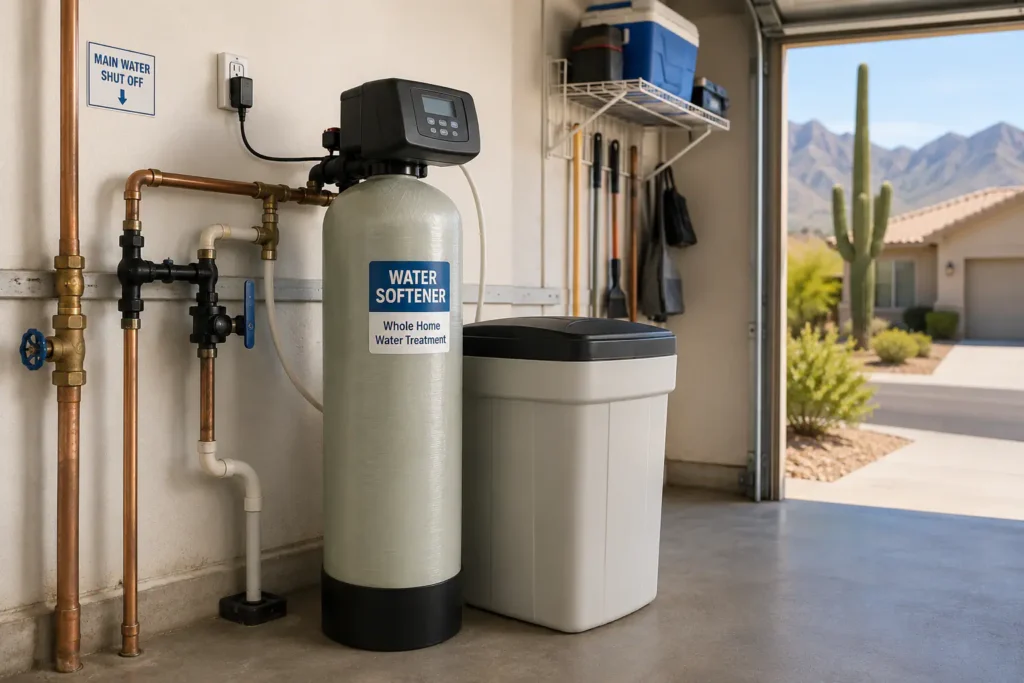
If you’re thinking about installing a water softener in your Tucson home, the first question is usually simple: How much will it cost?
The answer depends on much more than the price of the softener itself. Your total cost can change based on the system’s capacity, whether your home already has a water softener loop, where the equipment will be installed, how much plumbing work is needed, and whether you choose a basic softener or a more advanced water treatment system.
For a typical Tucson homeowner, a basic softener can cost several hundred dollars for the equipment alone, while a professionally installed system can run into the thousands depending on the equipment and plumbing work involved.
The City of Tucson says retail prices for residential water softeners are approximately $400 to $1,200, depending on the size and type of system. Installation is a separate expense and can vary significantly from one home to another.
Here’s what you need to know before getting a quote.
How Much Does a Water Softener Cost in Tucson?
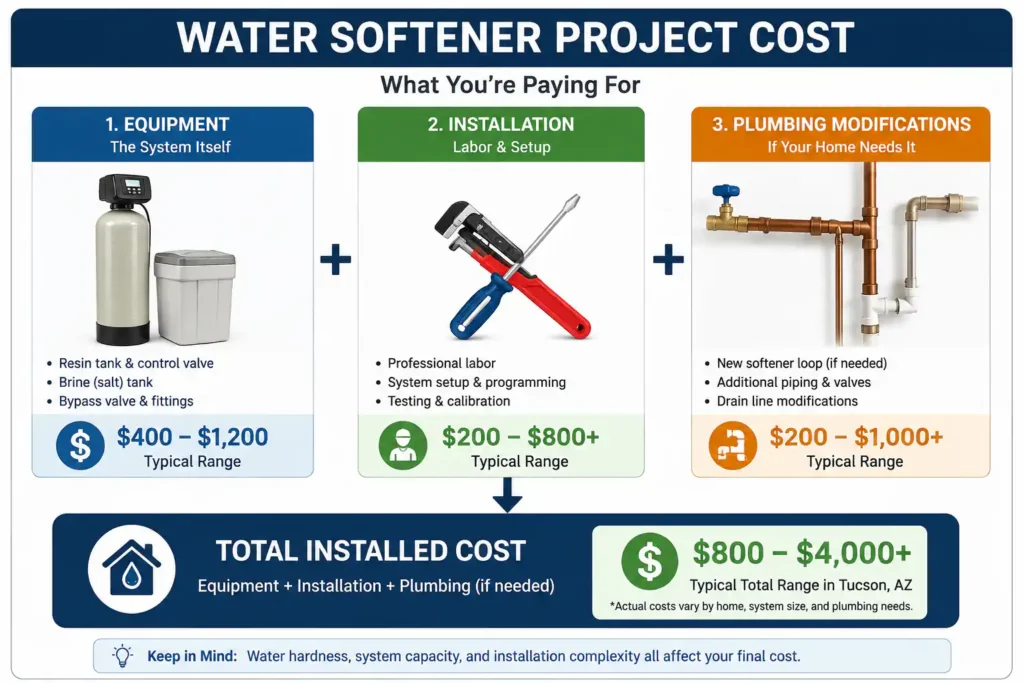
A useful way to think about the price is to separate the equipment cost from the installation cost.
| Cost | Typical planning range |
|---|---|
| Basic water softener equipment | $400–$1,200 |
| Straightforward installation | Several hundred dollars |
| New softener loop or additional plumbing | $200–$1,000+ |
| Premium whole-house systems | $2,000–$4,000+ |
| Salt or potassium chloride | About $5–$7 per 40-lb. bag |
These are planning figures, not guaranteed Tucson quotes. The final price depends on the home and system.
For example, the City of Tucson currently lists residential softener equipment at about $400–$1,200. It also reports salt or potassium chloride at approximately $5–$7 per 40-pound bag.
Local Tucson pricing can be considerably higher for premium equipment and more involved installations. One Tucson water-treatment company, for example, advertises approximately $2,400 for a particular system when a pre-plumbed soft-water loop and drain are already available. Local homeowners have also reported quotes around $3,200–$3,600 for more extensive systems.
The important takeaway: Don’t compare water softener prices by looking at the equipment price alone. Ask what the quote includes.
Why Is Water So Hard in Tucson?
Tucson is known for hard to very hard water.
According to the City of Tucson, water hardness comes primarily from naturally occurring calcium and magnesium. The city classifies Tucson’s water as hard to very hard, depending on the water source and location.
Hardness is commonly measured in grains per gallon (GPG) or milligrams per liter (mg/L).
One grain per gallon is equal to approximately 17.1 mg/L of calcium carbonate. That’s an important number because water softeners are sized according to the amount of hardness they can remove before regeneration.
Your actual water hardness can vary by location. Tucson Water provides an online water-quality map where homeowners can check test results from sampling points near their address, including hardness information used for water-softener settings.
That means you shouldn’t automatically buy a large softener simply because you live in Tucson.
The right system should be sized for your household water demand and the hardness of your water.
What Does a Water Softener Actually Do?
A traditional water softener uses ion exchange to reduce calcium and magnesium in the water.
Inside the softener is a resin tank containing tiny resin beads. As hard water passes through the tank, calcium and magnesium ions are exchanged for sodium or, in some systems, potassium.
Eventually, the resin becomes loaded with hardness minerals.
The system then goes through a regeneration cycle, flushing the accumulated minerals from the resin and restoring its ability to soften water.
This is different from a basic water filter.
A filter may remove or reduce certain particles, chlorine, sediment, or other contaminants. A conventional softener is specifically designed to address water hardness.
That’s why homeowners sometimes need both a water softener and a separate filtration or reverse-osmosis system.
What Is Included in a Water Softener Installation?
A professional installation may involve much more than placing two tanks in the garage.
A typical installation can include:
- Water softener equipment
- Brine tank
- Resin tank
- Control valve
- Bypass valve
- Shutoff valves
- Water supply connections
- Drain connection
- Brine line
- Electrical connection, when required
- Programming the control valve
- Testing the system
- Setting hardness and regeneration parameters
The amount of work depends heavily on the plumbing already in your home.
That’s why two Tucson homeowners can receive very different installation quotes for seemingly similar systems.
Does Your Tucson Home Have a Water Softener Loop?
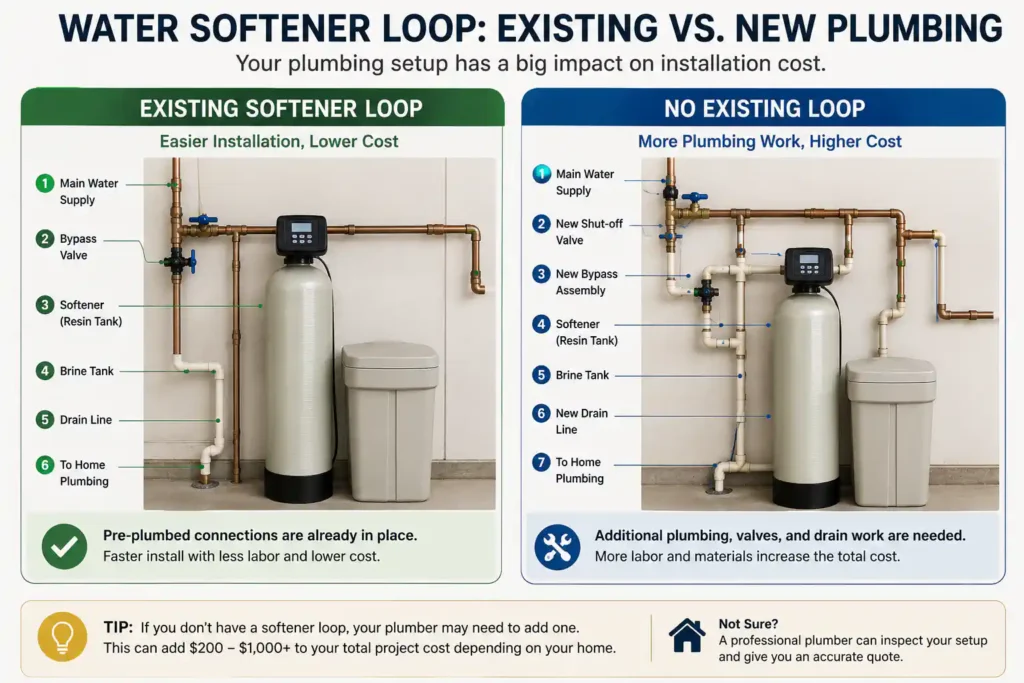
This is one of the biggest questions to ask before getting a quote.
A water softener loop is a pre-plumbed connection that makes it easier to install a softener. It is commonly found in or near the garage and is designed to provide the necessary water connections and a path for the system’s discharge.
If your home already has a loop, installation can be relatively straightforward.
If it doesn’t, the plumber may need to modify existing plumbing to create the required connections.
That can increase labor and material costs.
A local Tucson water-treatment company estimates that creating a new soft-water loop can cost roughly $200–$1,000, depending on the home’s plumbing configuration.
How to Find Your Softener Loop
Look around your garage, utility area, or near the home’s main water entry point.
You may see two capped water lines or a set of pipes that appears to be designed for water-treatment equipment.
If you’re not sure what you’re looking at, don’t cut or disconnect anything. A plumber can identify the connections and determine whether they are suitable for a softener.
What Factors Affect Water Softener Installation Cost?
Several variables can change your final quote.
1. System Capacity
Water softeners are commonly rated by grain capacity, such as 32,000, 48,000, or 64,000 grains.
A larger home with more occupants and greater water use may require more capacity than a small household.
But bigger isn’t automatically better.
An oversized system can be inefficient if it regenerates less effectively than a properly sized unit.
A good sizing calculation considers:
Number of people × average daily water use × water hardness
A plumber or water-treatment professional can use those factors to determine an appropriate capacity.
2. Water Hardness
The harder the water, the more hardness minerals the softener has to remove.
Tucson’s water conditions make this especially important.
The City of Tucson notes that hardness can vary and provides location-specific water-quality information rather than treating the entire service area as having one identical hardness level.
3. Existing Plumbing
A home with a properly installed softener loop, nearby drain, and suitable electrical outlet may require less work.
An older home without those connections may require additional plumbing.
That can include:
- Cutting and reconnecting water lines
- Installing shutoff valves
- Creating a bypass
- Adding a drain line
- Relocating plumbing
- Creating a soft-water loop
- Running piping to the installation location
4. Installation Location
A garage installation is often convenient because the equipment can remain outside the main living space and near existing plumbing.
But the best location depends on where your main water line enters the home and how the plumbing is configured.
Outdoor installation may also be possible, but Tucson’s extreme summer heat means the equipment and installation location should be selected carefully according to the manufacturer’s requirements.
5. Type of Water Treatment System
Not every system marketed for hard water is the same.
You may encounter:
- Conventional salt-based softeners
- Salt-free conditioners
- Whole-house filtration systems
- Carbon filtration
- Softener and filtration combinations
- Reverse-osmosis drinking-water systems
These systems solve different problems.
A salt-based water softener actually removes hardness minerals through ion exchange.
A salt-free conditioner generally works differently and should not automatically be considered equivalent to a conventional softener.
If your main problem is scale from calcium and magnesium, make sure you understand exactly what the system is designed to do before comparing prices.
Salt-Based vs. Salt-Free: Which Costs More?
A salt-based softener normally requires periodic salt replacement and regeneration.
The City of Tucson estimates sodium or potassium chloride at approximately $5–$7 per 40-pound bag, although actual retail prices can vary.
Salt-free systems may avoid traditional salt replenishment, but they are not simply a cheaper version of a conventional softener.
The more important question is:
Do you want to reduce water hardness, or do you primarily want to control scale?
Those are not necessarily the same goal.
If you’re comparing systems, ask the installer to explain the expected result rather than relying only on marketing terms such as “water conditioner,” “descaler,” or “salt-free softener.”
How Much Does It Cost to Run a Water Softener?
The purchase price is only part of the long-term cost.
You should also consider:
- Salt or potassium chloride
- Water used during regeneration
- Electricity, if required by the control valve
- Replacement parts
- Resin replacement eventually
- Professional service
- Repairs
- Filter replacement if your system includes filtration
A properly maintained softener can last for many years. The City of Tucson notes that some older softeners supplied in the 1980s are still operating, although equipment life varies considerably by model, maintenance, water conditions, and use.
Can a Water Softener Save Money?
It can, although you shouldn’t assume that every system will pay for itself quickly.
Hard water can create scale buildup inside plumbing and water-using appliances.
The City of Tucson notes that scale can restrict water flow and reduce water-heater efficiency. It estimates that hard water can increase domestic water-heating costs by approximately 15%–20% and can shorten the life of appliances such as dishwashers.
A softener may also make cleaning easier by reducing mineral deposits on:
- Shower doors
- Faucets
- Sinks
- Bathtubs
- Dishes
- Fixtures
So the value isn’t necessarily just lower utility bills. It can also involve appliance protection, less scale buildup, and reduced cleaning effort.
Do You Need a Water Softener in Tucson?
Not every homeowner needs one.
The better question is whether your home’s water hardness and your household’s goals justify the cost.
A softener may make sense if you’re dealing with:
- White mineral deposits on faucets
- Scale around showerheads
- Spots on dishes and glassware
- Poor soap lather
- Mineral buildup in fixtures
- Scale concerns inside water-using appliances
- Hard-water buildup around plumbing
However, hard water itself isn’t automatically a health problem.
The City of Tucson states that calcium carbonate hardness is not associated with health concerns, although hard water can create household nuisances such as scale and mineral deposits.
If you’re unsure, start with a water-quality test or check your local Tucson Water results before spending thousands of dollars on equipment.
Should You Buy the Softener Yourself or Hire a Plumber?
Buying equipment separately can reduce the upfront equipment cost, but installation still requires the plumbing to be done correctly.
A DIY installation may be reasonable for someone who is comfortable working with plumbing and understands the manufacturer’s installation requirements.
For many homeowners, professional installation is worth considering because a plumber can:
- Verify the water supply
- Check the existing plumbing
- Identify the softener loop
- Install or modify drain connections
- Install shutoff and bypass valves
- Prevent leaks
- Set up the regeneration cycle
- Test the system after installation
If the home requires a new loop or significant plumbing modifications, professional installation becomes even more important.
Questions to Ask Before Accepting a Water Softener Quote
Don’t compare quotes based on the final dollar amount alone.
Ask each installer:
- What exact softener model is included?
- What is the grain capacity?
- What water hardness are you using for sizing?
- Is the installation based on an existing softener loop?
- Is the drain connection included?
- Are shutoff and bypass valves included?
- Does the price include all plumbing modifications?
- Are permits required for the proposed work?
- Is programming and startup included?
- What ongoing maintenance will the system require?
- What is the warranty on the equipment?
- What is the warranty on the plumbing installation?
- Are there recurring service or maintenance fees?
- What happens if the system needs repair?
These questions can reveal why one quote is $1,000 and another is several thousand dollars.
Is a $3,000 Water Softener Worth It?
It depends on what you’re getting for the $3,000.
A high-priced system isn’t automatically better than a less expensive one.
Before paying a premium, compare:
- Actual softening capacity
- Control valve quality
- Regeneration efficiency
- Water and salt consumption
- Warranty
- Resin quality
- Installation quality
- Service availability
- Replacement-part availability
Tucson homeowners have reported professional quotes in the $3,000-plus range for systems that included more than a basic softener, while other homeowners report substantially lower costs when purchasing equipment separately or using simpler installations.
The key is to compare what is included, not just the price.
What Should You Expect to Pay?
For a Tucson homeowner, a reasonable starting point is to think about the project in three parts:
Equipment: The City of Tucson lists approximately $400–$1,200 for residential water softener retail prices, depending on the system.
Basic installation: A straightforward installation can cost several hundred dollars when the necessary plumbing is already available. One Tucson-area cost estimator currently puts a typical installation project around $518–$695, although estimates like this should not be treated as a guaranteed contractor quote.
More involved or premium installations: Systems with upgraded equipment, filtration, new plumbing, or a new softener loop can push the project into the $2,000–$4,000+ range. Local Tucson examples show why these higher quotes exist.
So, rather than asking, “What’s the average water softener cost in Tucson?” a better question is:
“What will it cost to install the right system in my particular home?”
Frequently Asked Questions
How much does a water softener cost in Tucson?
The equipment alone can cost approximately $400–$1,200 according to the City of Tucson. Total installed cost can range from several hundred dollars for a straightforward installation to several thousand dollars for premium equipment or homes requiring additional plumbing.
How much does it cost to install a water softener in Tucson?
Installation cost depends on the existing plumbing, softener loop, drain connection, equipment, and location. A simple installation may cost several hundred dollars, while more complicated projects can cost substantially more.
Does Tucson have hard water?
Yes. The City of Tucson classifies its water as hard to very hard, although hardness varies by water source and location.
How do I know what size water softener I need?
Sizing depends primarily on household water use and water hardness. Grain capacity should be matched to the amount of hardness your household needs the system to remove.
Do I need a water softener loop?
No, not necessarily. A softener can be installed without an existing loop, but creating the necessary plumbing connections can increase the project cost.
How often does a water softener need salt?
It depends on water hardness, household water use, system capacity, and regeneration settings. A properly sized and programmed system should regenerate based on actual demand rather than following an arbitrary schedule.
Is a water softener the same as a water filter?
No. A conventional softener is designed primarily to reduce calcium and magnesium hardness. A water filter may target sediment, chlorine, or other substances. Some homes use both systems.
Can a water softener damage plumbing?
A properly installed and maintained softener is designed to work with a home’s plumbing system. The more important issue is making sure the equipment is correctly sized, installed, programmed, and maintained.
Final Takeaway
For Tucson homeowners, water softener system cost can vary from several hundred dollars to several thousand dollars, depending on the equipment and installation requirements.
The City of Tucson’s $400–$1,200 retail equipment range is a useful starting point, but it doesn’t represent the complete installed project.
Before buying, check your home’s water hardness, determine whether you already have a softener loop, decide whether you need actual water softening or simply scale control, and get an itemized installation quote.
Most importantly, don’t choose a system simply because it has the highest grain capacity or the highest price.
The best water softener is one that is properly sized for your Tucson home’s water hardness, household demand, plumbing setup, and long-term maintenance budget.

Leave a Reply